
An afternoon at Powerhouse, somewhere between human ambition and existential dread.
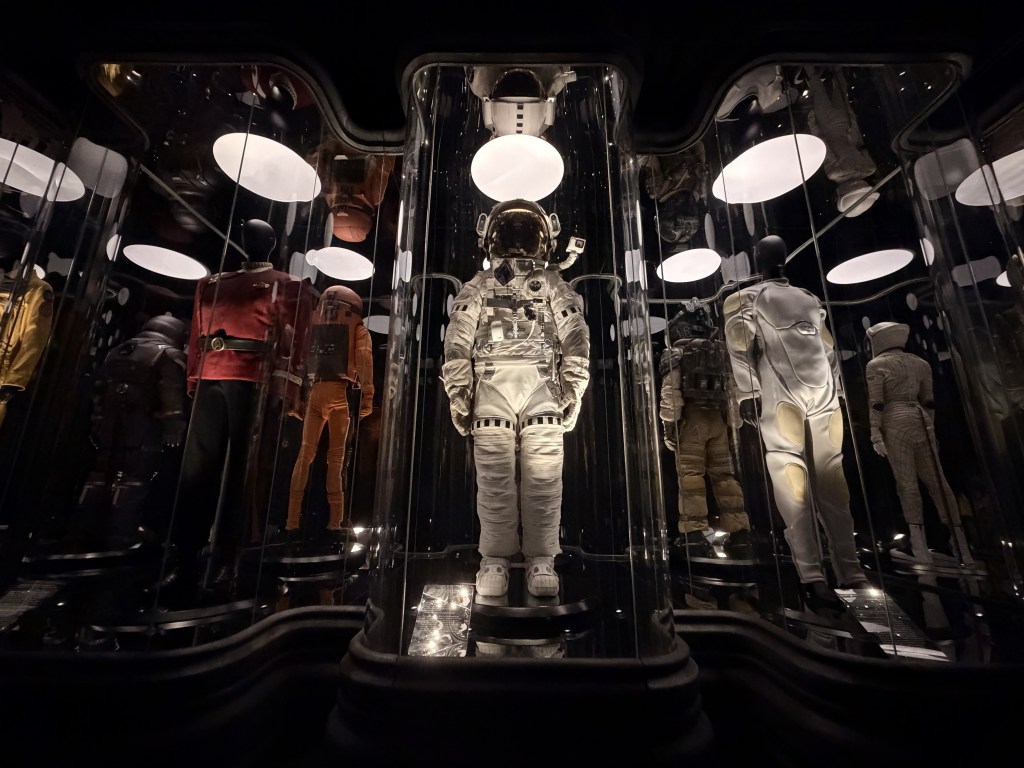
The most unsettling thing I saw at Powerhouse was not the wreckage of an aircraft. It was a spacesuit.
An enormous, almost intimidating figure, with a dark visor that revealed absolutely nothing behind it. I stared into that black surface, trying to imagine the face inside. The longer I looked, the less human it seemed. It reminded me of a black hole, as though I were looking into something vast, silent and unknowable.
Then an uncomfortable thought occurred to me.
What if there wasn’t a human inside?
Not quite what I expected to take away from an exhibition about humanity’s greatest adventures.
High Hopes, Hard Landings
Reaching is not owning.
Task Eternal takes visitors through humanity’s rather stubborn determination to get off the ground.
From ancient kites and the Greek myth of Icarus to Leonardo da Vinci’s studies of bird wings, we spent centuries imagining what evolution had neglected to give us. The Wright brothers eventually turned imagination into engineering.
But gravity was hardly the only obstacle. Pioneering female aviators challenged a world that had decided flying was a man’s business. Curiosity, commerce and the desire to travel further pushed aviation forward, while military demands accelerated some of its breakthroughs.
The Cold War then turned space exploration into a contest of national prestige as much as scientific discovery.
Apparently, nothing motivates human ingenuity quite like the possibility of someone else getting there first.
And in 1969, humans walked on the Moon.
Something that had belonged to mythology and poetry for millennia suddently had footprints. I find that extraordinary.
Yet what made me linger were the less celebrated objects: pilots’ logbooks, training records, aircraft engines, black boxes and the remains of an aircraft that never made it home.
They told a different story. Progress looks reassuringly linear when measured by milestones. The wreckage reminds us that history also advances through failure, loss and lessons learned at a terrible cost.
We now cross continenets at 35,000 feet while comlaining about insufficient legroom. A triumph of human ingenuity, reduced to a customer service issue.
Perhaps that is the ultimate achievement of technology: making the extraordinary ordinary.
But success can also make us a little too confident.
We speak of conquering the skies, conquering space and colonising Mars. Yet learning to fly did not mean defeating gravity. It meant understanding enough of its rules to work within them.
Reaching is not owning. Nor is discovery necessarily understanding.
History offers enough cautionary tales about exploration turning into conquest. I wonder whether we will carry those same assumptions with us beyond Earth.
After all, the universe is not an empty territory waiting for a flag. And if something is already out there, who gave us the right to claim it?
Dark Visors, Blind Spots
Seeing is not understanding.
Back to that spacesuit.
I imagined a visitor from another civilisation standing before me. Towering, unfamiliar, impossible to read.
Would I be curious? Absolutely.
Would I be terrified? Even more so.
Rather inconvenient, considering how much I admire humanity’s appetite for exploration.
Perhaps the unknown is more appealing when we are the ones doing the discovering.
Stephen Hawking once warned that contact with a far more advanced extraterrestrial civilisation might not end particularly well for humanity. It was a speculative concern, but one that raises an uncomfortable question.
We imagine ourselves as explorers. What if we became the explored?
Perhaps somewhere in the depth of the universe, another civilisation is looking towards Earth, wondering whether this little planet might harbour life. Perhaps, to them, we are the mysterious strangers.
Would they recognise us as intelligent? And would we recongise them?
My imaginary alien stood upright, wore a spacesuit and apparently had a face behind its visor. It might even look just like one of us.
Even our wildest science fiction tends to give extraterrestrials familiar bodies, emotions and ambitions. We project ourselves onto worlds we have never visited, then congratulate ourselves on our imagination.
But why should intelligence elsewhere resemble ours?
Another civilisation might experience reality through senses we do not possess, communicate in ways we cannot detect, or exist on timescales we struggle to comprehend.
The Fermi paradox captures another part of the mystery: given the vastness and age of the universe, where is everybody?
Perhaps intelligent life is extraordinarily rare. Perhaps the distances are simply too great. Or perhaps we have not yet learned where, or how, to look.
That last possibility particularly intrigues me.
We have built telescopes capable of observing distant galaxies, yet our understanding remains shaped by the experiences of a species that evolved on one small planet.
Seeing is not understanding.
And the absence of evidence is not necessarily evidence of absence.
We may have developed extraordinary tools to explore the universe, but have we developed an equally extraordinary ability to question our own assumptions?
Escaping Earth’s gravity may be easier than escaping an Earth-centred imagination.
Perhaps our greatest blind spot is assuming that the unknown must somehow make sense to us.
Distance Stars, Familiar Ground
Small is not necessarily insignificant.
I looked again at the spacesuit.
There was something wonderfully ironic about it. We have spent thousands of years trying to leave Earth, only to discover that surviving beyond it requires carrying a tiny, artificial version of its environment with us.
All that engineering, just to make breathing possible.
The exhibition’s subtitle, To Fly, Leave Earth, Return, suddenly seemed particularly fitting.
We celebrate departures: the first flight, the first journey beyond Earth’s atmosphere, the first footsteps on the Moon. Yet perhaps one of the most profound consequences of space exploration has been looking back.
From space, Earth appears as a small planet suspended in darkness, its political borders invisible. All our civilisations, conflicts, achievements and ambitions occupy a tiny corner of an unimaginably vast universe.
For centuries, we believed ourselves to be at the centre of existence. Astronomy gradually dismantled that comforting assumption. Earth was not the centre of the Solar System. Our Sun turned out to be one star among billions, in a galaxy that is itself one among countless others.
The more we learned about the universe, the less central we became.
Perhaps that is one of exploration’s greatest achievements. Not conquering new worlds, but forcing us to reconsider our place in the one we inhabit.
And somewhere within that immense universe is me.
One person, on one planet, contemplating an imaginary alien in a museum on an otherwise ordinary afternoon.
Hardly the centre of the universe.
I began to wonder how much of what we consider important would matter from a cosmic perspective. Our ambitions, anxieties, achievements and disagreements, the things that can occupy our thoughts for days or even years, would barely register against billions of years of cosmic history.
It is a rather humbling thought.
But small is not necessarily insignificant.
There is a difference between being insignificant to the universe and being insignificant within it.
The universe does not have to revolve around us for our existence to matter. Our curiosity, creativity and capacity for understanding may not make us its masters, but they make our brief existence rather extraordinary.
Stephen Hawking spent much of his life asking questions about the universe’s origins and fundamental laws. Yet perhaps one of the most fascinating questions is not simply how the universe came to exist, but how a small part of it came to develop the ability to question its own existence.
We are made of the same fundamental ingredients as the stars we study. Somehow, through billions of years of cosmic and biological evolution, those ingredients became capable of observing, wondering and asking why.
The universe is not merely something we look at. We are part of it.
And perhaps that changes the question.
Instead of asking whether we matter to the universe, perhaps we should ask what it means to be a conscious part of it.
I left Powerhouse feeling strangely proud of how far humanity has come, and considerably less certain about how much we really know.
From watching birds to building aircraft, from walking on Earth to walking on the Moon, our journey has been extraordinary. But the further we travel, the more we discover about our limitations, our assumptions and the extraordinary circumstances that make our existence possible.
We have learned to leave Earth. Perhaps we are still learning what it means to belong here.
I walked out beneath an ordinary sky, grateful for the familiar ground beneath my feet and the simple luxury of breathing without a spacesuit.
A little more down to earth, in more ways than one.
We may be nothing more than dust in the universe.
But what a curious thing it is, for dust to wonder where it belongs. ▲

